
How to choose a safe overnight camp in Washington: what to check
Sources accessed November 2, 2026. Last reviewed November 2, 2026.
Sending your child to overnight camp is a big, happy step. A little homework helps you feel sure about your choice. Here is what Washington checks, what it leaves to camps, and the friendly questions that fill in the rest.
General information, not legal advice. This guide summarizes public sources as of the date above. We don’t rate or rank camps. No license, accreditation, or checklist can promise a risk-free camp, so use these steps to start a good conversation with the camp.
The short version
- Ask whether the camp is registered with its local health department under WAC 246-376.
- Check whether the camp is accredited by the American Camp Association (ACA), and how to confirm it.
- Ask how staff and volunteers are screened, trained, and supervised.
- Ask who handles health care and medication on site.
- Ask to read the camp’s emergency and reporting plans.
What Washington checks: health department registration
Washington’s camp rule is chapter 246-376 WAC (opens in a new tab) (accessed November 2, 2026). It applies to an established group camp run for recreation, education, vacation, or religious purposes, with closely supervised activities and food and lodging provided (WAC 246-376-010).
According to that rule:
- Every camp owner must apply each year to the local health officer to register the camp, at least 30 days before it opens (WAC 246-376-020).
- The rule sets standards for the camp site, toilets and handwashing, showers, and sleeping quarters, including at least 40 square feet of floor space per person in cabin or dormitory sleeping rooms (WAC 246-376-030 through 246-376-090).
- Camps must be supervised by an adult with mature judgment who can understand and apply the state rules, and the premises must be inspected often for sanitation (WAC 246-376-040).
- If a condition is a violation or a menace to health, the health officer may order the camp closed until it is fixed (WAC 246-376-120).
Notice what the rule focuses on: the site, sanitation, and living spaces. It does not set rules for staff screening, counselor ratios, or health staff. Those are questions to ask the camp. The Legislature’s site lists the chapter’s last update as 1997.
Registration happens through the local health department where the camp is located. The Department of Health keeps a list of local health jurisdictions (opens in a new tab) (accessed November 2, 2026) if you’d like to contact one.
What Washington doesn’t do: license summer camps as child care
The Department of Children, Youth, and Families (DCYF) licenses child care under chapter 43.216 RCW. According to RCW 43.216.010(2)(g) (opens in a new tab) (accessed November 2, 2026), that law’s definition of a child care “agency” does not include a seasonal camp. A seasonal camp is a program that operates for three months or less in any twelve months and is mainly recreational or educational, run on a closely supervised basis.
In plain terms, a typical summer overnight camp is not licensed by DCYF the way a child care center is. That makes your own questions, and voluntary accreditation, more useful.
Voluntary accreditation: the American Camp Association
According to the ACA’s key messages for parents (opens in a new tab) (accessed November 2, 2026), ACA accreditation is voluntary. It means a camp has gone through a review of its operation against up to 266 standards, covering staff qualifications, training, and supervision; health, wellness, and first aid; emergency preparedness and drills; program safety; and transportation, facilities, and camp operations.
To confirm a camp’s status:
- Search the ACA’s Find a Camp (opens in a new tab) directory (accessed November 2, 2026).
- Listing in that directory is optional, so not every accredited camp appears. If you don’t find a camp, the ACA says to call 1-800-428-CAMP or email accreditation@acacamps.org.
Many careful camps aren’t accredited. The ACA suggests that if a camp isn’t, you ask why and learn about its health, safety, staffing, and operations practices. The ACA also says plainly that no accreditation, license, or law can guarantee safety.
Staff: screening, training, ages, and ratios
Background checks
Washington law lets an organization that supervises or provides recreation to children under 16 ask the Washington State Patrol for an applicant’s conviction record (RCW 43.43.830(3) (opens in a new tab) and RCW 43.43.832(1)(a) (opens in a new tab), accessed November 2, 2026). Under RCW 43.43.834 (opens in a new tab) (accessed November 2, 2026), the organization must tell applicants that a check may be made and must ask applicants whether they have been convicted of a crime.
Friendly questions to ask:
- Which background checks do you run, and for whom (staff, volunteers, contractors)?
- Do you check references for every counselor?
- What training do staff complete before campers arrive?
Counselor ages and ratios
According to the ACA’s How to Choose a Camp: Safety Tips (opens in a new tab) (accessed November 2, 2026), ACA standards generally use these overnight camp ratios:
- One staff member for every 5 campers ages 4 and 5
- One staff member for every 6 campers ages 6 to 8
- One staff member for every 8 campers ages 9 to 14
- One staff member for every 10 campers ages 15 to 17
The same page says ACA standards call for staff to be at least 16 years old and at least two years older than the campers they work with, and recommend that 80 percent or more of counseling and program staff be at least 18. It also says staff should be trained in safety rules, emergency procedures, behavior management, child abuse prevention, appropriate staff and camper behavior, and supervision.
These are ACA’s standards, not Washington law. They give you a helpful yardstick when you ask a camp about its own numbers.
Health care and medication
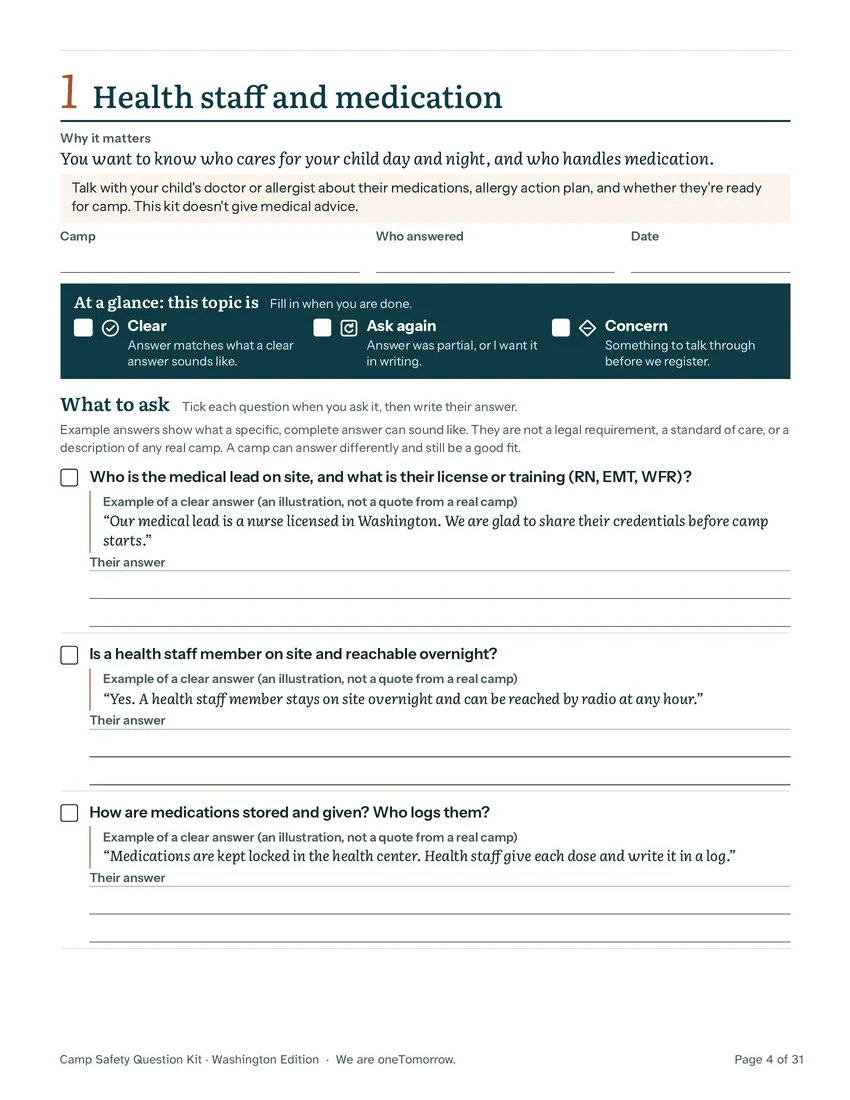
The ACA lists health care staff, medication management, and health records among the areas its standards cover. Washington’s camp rule doesn’t set health staffing, so ask:
- Who is the medical lead on site, and what is their license or training?
- How are medications stored and given, and who keeps the record?
- How do you handle allergies and emergency medicine like epinephrine?
- When and how would you call me if my child is sick or hurt?
Our free health staff and medication sample has these questions with examples of clear answers.
Emergency plans and reporting concerns
Ask to read the camp’s written plans for emergencies, evacuations, and how families are contacted. Two of our guides help with this:
- How to check a Washington camp’s flood and wildfire smoke risk
- Who must report abuse at a Washington camp?
A clear answer usually names a person or role, a written plan, and how you would hear from the camp. Record what you learn on the free Compare camps worksheet, and browse what camps publish in our Washington overnight camp directory.
Sources
- Chapter 246-376 WAC, Camps (opens in a new tab) — Washington State Legislature, accessed November 2, 2026
- RCW 43.216.010, Definitions (opens in a new tab) — Washington State Legislature, accessed November 2, 2026
- RCW 43.43.830, Background checks — Definitions (opens in a new tab) — Washington State Legislature, accessed November 2, 2026
- RCW 43.43.832, Background checks — Disclosure of information (opens in a new tab) — Washington State Legislature, accessed November 2, 2026
- RCW 43.43.834, Background checks by business, organization, or insurance company (opens in a new tab) — Washington State Legislature, accessed November 2, 2026
- Washington State Local Health Jurisdictions (opens in a new tab) — Washington State Department of Health, accessed November 2, 2026
- ACA Accreditation: Key Messages for Parents (opens in a new tab) — American Camp Association, accessed November 2, 2026
- How to Choose a Camp: Safety Tips (opens in a new tab) — American Camp Association, accessed November 2, 2026
- Find a Camp (opens in a new tab) — American Camp Association, accessed November 2, 2026
Want every question in one place?
The WA Camp Safety Question Kit turns this checklist into printable questions, with an example of a clear answer for each and the official sources to check. It covers 14 topics and 57 questions in all.